




November 20, 2026
Cristina Otero
October 08, 2026
,
Cristina Otero
How to Play Pickleball: The Complete Beginner’s Guide
An increasingly popular racquet sport, pickleball is nevertheless a newbie compared to other sports with rich and long histories. Created in 1965 in the Pacific Northwest, pickleball is a cobbled-together mesh of badminton, tennis, and ping-pong. As a low-impact game with tons of health benefits and an inclusive culture, learning how to play pickleball is straightforward and fun. This handy guide will walk you through the rules of pickleball and set you up for success in the courts.
Equipment & Court
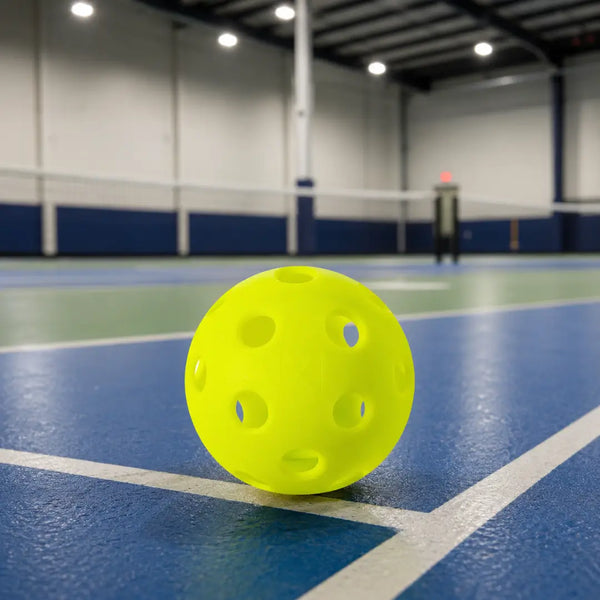
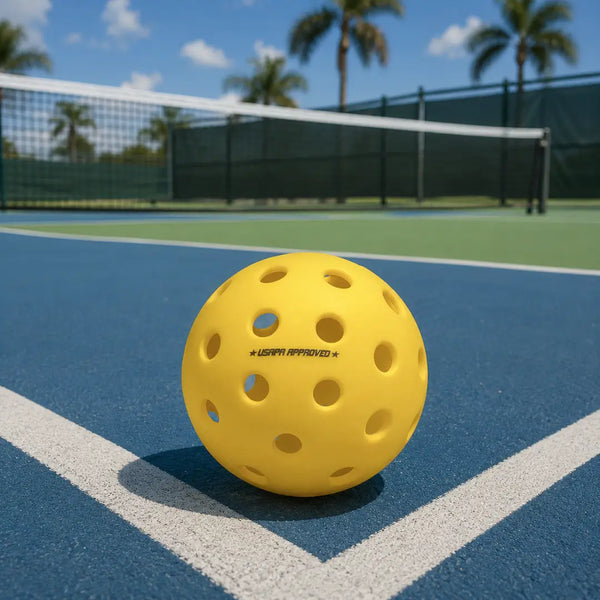
Pickleball is played as one long game, or rally, using pickleballs and paddles. Unlike in tennis or badminton, a pickleball is a plastic ball with holes in it; they also have a lower bounce than tennis balls. The paddle is much like a ping-pong paddle except larger and heavier, and there are no strings unlike tennis and badminton racquets.
Although it can be played as a singles game, pickleball is traditionally a doubles game, which means there are two players on each team. Either way, the same court size, layout, and basic rules apply. For beginners, learning how to play doubles games first is recommended.
The pickleball court is similar in size to a badminton court, covering approximately 880 square feet, with a net height of 36 inches at the sidelines and 34 inches at the center. There is a centerline dividing the right and left serving area. Close to the net is the non-volley zone, or kitchen area. The baseline is at the back of the court and the sidelines surround it. Learn more pickleball terms and vocabulary here.
7 Rules for Pickleball Doubles
Pickleball is easy to learn and play for beginners, those who already have experience playing a racquet sport before like tennis will find the rules and gameplay familiar. There are many rules to keep in mind, but these seven are by far the most important:
- Each rally begins with a serve. The player on the right side of the court always starts the serve, and it is always diagonally to their opponent. You can either hit the ball after it bounces out of the air, but regardless, it must clear the kitchen. The paddle must move in an upward arc when you strike. Specifically, volley serves must be executed with an underhand forehand or backhand strike, again with contact below the waist.
- The ball must bounce once on each side before either team can volley. This must be done at the beginning of the rally; after that, both teams are free to volley. The two-bounce rule aims to slow the server’s advantage, giving both sides a chance to move into position. It also encourages smart third shots. That way, the game can be kept fair.
- Each point continues until a fault is committed. Gameplay continues until the rally is won by someone hitting a winning shot or a fault is committed. Some basic faults include the ball landing out of bounds, the ball hitting the net, and the ball bouncing twice on one side before the player can return it. If you’re unsure whether the ball landed within the court or out of bounds, give the benefit to your opponent.
- You cannot volley in the kitchen. The kitchen or non-volley zone is a seven-foot zone on each side of the net. You cannot initiate a volley; however, you can hit the ball if it bounces in the kitchen. If your opponent hits a short shot landing in the kitchen, you can enter and return it.
- You can only win points on your serve. Until you lose a rally, you continue serving. After winning each point on your serve, you switch sides with your partner (from left to right) and serve to the other opponent. Once your team loses a point, your teammate begins serving until another point is lost. Then the serve switches or “sides out” to the other team.
- The correct score must be called before serving. Pickleball scoring is announced in three numbers, such as “0-0-2” for the very first serve. The first number is the score of the serving team, the second is the score of the receiving team, and the third is the team player serving, either the first (1) or the second one (2). If you lose a rally, the ball does not go to your opponent, but to your teammate, who must announce the scores. If your teammate loses their serve, it is then the opponents’ turn to serve and announce the scores. An alternative format, called rally scoring, allows either team to score on a rally; these games are typically played to 15 or 21 points.
- The first team to reach 11 points wins, but it must win by two points. The game only ends once one team gets 11 points. They must, however, be ahead of the other team by two points. Thus, for the game to end, the score must be either 11-9, 12-10, 15-13, or even 21-19.
The rules for singles games are basically the same, with one variation: The announced score involves only two numbers and not three.
Tips for Beginners
While pickleball is easy to pick up, mastering it takes time. Although most players can sustain a rally within one or two sessions, instincts and habits developed from other racquet sports can derail your success in the sport.
For beginners, we recommend simple tips that will help you develop the right habits, especially if you are familiar with other racquet ball sports. These habits can set you up for success and, of course, pickleball mastery. You can learn more beginner pickleball tips here.
- Internalize the two-bounce rule. Remember that the ball must bounce once on each side of the net before either team can volley. This means that the serving team must wait at the baseline after serving and cannot rush to the net immediately. A common beginner error is charging forward after the serve and getting caught in no-man’s land after the return comes back.
- Keep serves deep and consistent, not powerful. Players used to the powerful serves encouraged in sports like tennis will flounder in a smaller space and net. In pickleball, strategically deep serves that land within three feet of the baseline allow you to push your opponent behind the baseline and gives you time to get into position. To execute these serves, it is important to keep your arm relaxed, your wrist firm, and your contact point below your waist.
- Keep your paddle at belly-button height at the kitchen line. This position will allow you to get both low dinks and high volleys. This allows you not to waste time lifting the paddle from the hip level.
- Master the dink shot. A dink is a soft, controlled shot hit from the kitchen line or near it, one that arcs over the net and lands in the opponent’s kitchen. One of the most important shots in pickleball, dinking can help you force errors from aggressive opponents and thus gain a key advantage. To execute a good dink shot, use a pendulum swing with a relaxed grip and contact the ball when it is still falling. Letting the ball rise too high before contact will produce a floating arc instead of the low trajectory you are aiming for.
- Return serves deep and with loft. Perform a deep, lofted shot to the middle-back of your opponent’s court. This return serve aims to drive your opponent back to the baseline, buying you some time to advance. After you execute the serve, move immediately toward the kitchen.
- Rush the kitchen line after every return. Going to the kitchen line before the next shot arrives is good practice overall. Unlike the baseline, where you must always be on the defense, players at the kitchen line can neutralize dinks and put away volleys.
- Learn the third shot drop ASAP. This soft shot hit from the baseline aims to land in your opponent’s kitchen. The third shot drop is difficult to execute because it requires very precise control: If the shot is too low it clips the net, but if it is too high, you may miss the kitchen, and your opponent can attack it. Once mastered, however, the third shot drop grants you huge advantage, allowing your team to advance and neutralize your opponent’s third shot drop advantage.
- Wear court shoes, not running ones. Opting for shoes specifically made for pickleball courts is requisite. For one thing, running shoes are engineered for forward motion and are not equipped to handle the quick lateral movements involved in pickleball. The cushioning involved in running shoes tends to give way to directional changes, which can increase the risk of ankle sprains. Court shoes do have that lateral support construction that helps keep the feet stable. Moreover, pickleball court surfaces are hard on both shoes and the body. With their tough outsoles and toe guards, court shoes are optimized for these kinds of courts and can last longer even with heavy use. We have tons of great options for pickleball shoes to explore here.
Choose composite or graphite paddles over wood ones. For beginners, having a paddle that is forgiving and responsive without the need for perfect technique is recommended. Paddles made from composite material provide a balanced feel and mid-power. Graphite paddles provide a crisp, fast response that will help your control. Wood paddles are much heavier and with a much smaller sweet spot, slowing you down and wearying your arm more.
If you feel like you are not progressing or else getting stuck, no worries: There are a few set ways to improve. Practicing, of course, is requisite, especially specific shots that build muscle memory. That way they will be easier to execute once on the court.
You should also be playing matches as often as you can. You can team up with a more experienced player through open play sessions or leagues and learn from their example. Lastly, watching professional players select shots, position themselves, and manage points will give you a clear idea of what good pickleball gameplay entails.
Keep Calm and Volley On
There is always a bit of a learning curve to starting, well, anything. A great advantage to pickleball is that learning the ropes is relatively easy, and as a sport it is accessible to people of all ages and skill levels. It is no wonder it is one of the fastest-growing racquet sports in recent years.
By following this beginner’s guide, you can begin your pickleball journey right and learn to get comfortable on the court. At Pickleball Express, we are dedicated to serving all your on-court and off-court needs. From novices to seasoned professionals, anyone can benefit from our high-quality products and services. Learn more about the sport through our blog or browse through our inventory.

