




November 20, 2026
Cristina Otero
November 20, 2026
,
Cristina Otero
Pickleball vs. Badminton: What's the Difference?
Not all racquet sports are alike in playability. Pickleball and badminton have many similarities as racquet sports, but even small differences can trip prospective players up. Whether you’re a badminton player curious about pickleball or a pickleball player wanting to give badminton a go, it’s important to know the demands, transferrable skills, and adjustments you would need to make to be successful in each sport.
History
Pickleball and badminton are popular sports, but their histories and the nature of their popularity couldn’t be more different.
Badminton originated in ancient Greece, China, and India as battledore and shuttlecock. It was finally brought to England from India in the early 1870s, first played in the Badminton estate in Gloucestershire. The International Badminton Federation was formed on July 5th, 1934, eventually changing its name to the Badminton World Federation. Since then, it is an internationally popular game, especially in China, Indonesia, Malaysia, and Denmark. It has been included in the Olympics since 1992.
Pickleball, by contrast, originated in the United States in 1965, created by bored families from Bainbridge Island, Washington using leftover sports equipment: A badminton court, paddleball paddles, a Wiffle ball, and a tennis net height. Since then, it has been the fastest-growing sport in the U.S. In 2022 it became the official state sport of Washington. There are many governing bodies for the sport, including the oldest, USA Pickleball, but none that are recognized as the official worldwide governing body. To learn more, check out our neat blog on pickleball’s quirky origins.

Court
Good news for players: Both pickleball and badminton courts are extremely similar. In fact, they have the same dimensions, 44 feet long and 20 feet wide. This is no coincidence, as the first game of pickleball was first played on a badminton court. The only difference is that for badminton, the width is reduced to 17 feet for singles, while pickleball courts remain the same size for singles.
The pickleball net is 36 inches (91 cm) at the sides and 34 inches (86 cm) in the middle. Badminton nets, by contrast, are nearly twice as high, with 61 inches (155 cm) at the posts and 60 inches (152 cm) at the center.
Another difference is the service area and lines. Badminton courts have a center line and a serving line 6.5 feet from the net. Badminton courts also lack the non-volley zone or kitchen that pickleball is famous for; they do have a right and left service box with a 2.5-foot rear alley zone. Pickleball courts, by contrast, are divided into two equal sections, each 15 feet long by 10 feet wide. A center line runs from the kitchen line to the baseline, whereas badminton courts’ center line runs the full length of the court.
Surface
Pickleball is usually played outdoors with hard surfaces such as concrete and asphalt, typically with an acrylic coating for extra protection. Indoor pickleball floors are typically hardwood, linoleum, or rubber, although some do have hard flooring to simulate the conditions and overall feel of outdoor courts.
Badminton courts, however, are traditionally made of wood or have synthetic flooring. In fact, wood is the BWF-preferred flooring, as it absorbs impact well and allows a controlled grip for rapid directional changes. Badminton can also be played on outdoor grass courts, but only recreationally.
Equipment
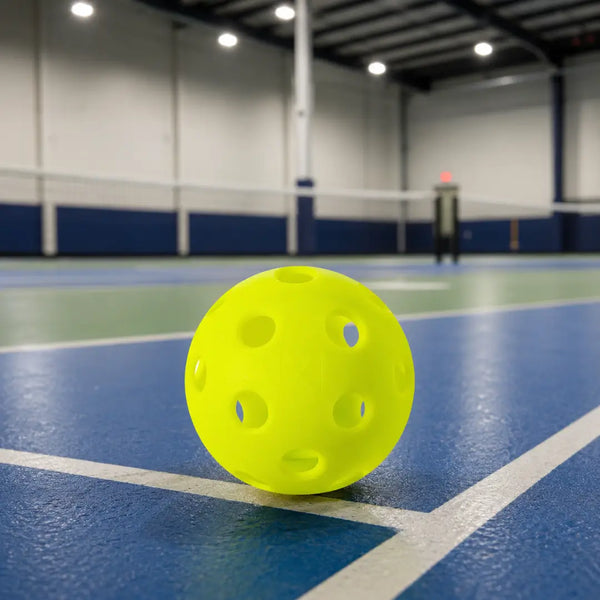
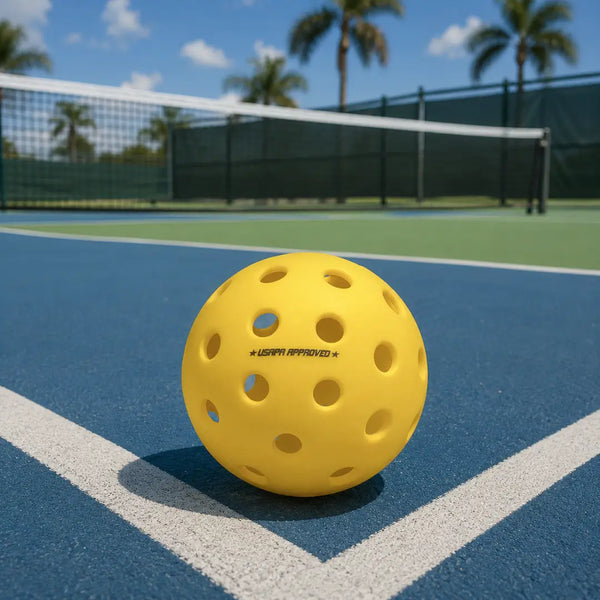
Pickleball and badminton differ the most by their equipment. Pickleball paddles are short and squat, with a flat solid surface and thick internal core. These paddles are usually 15.5-17 inches long and 7-8.25 inches wide. Pickleballs are made of hollow perforated plastic, ranging from 26 to 40 circular holes, and they come in three types: indoor, outdoor, and foam. Indoor pickleballs are softer, quieter, and a bit lighter than outdoor balls, while outdoor pickleballs are more durable. Foam pickleballs are the quietest of all, designed for courts with strict noise level rules.
Swipe to see more
Badminton racquets, on the other hand, are stringed and are longer, thinner, and sleeker than pickleball paddles. They are usually 26 inches long and 9 inches wide. Unlike other racquet sports, badminton uses a shuttlecock, with a feathered or plastic cone shape embedded in a rubber or cork base. This shuttlecock floats through the air faster than balls used in other racquet sports, and of course it doesn’t bounce as a pickleball does. In fact, the shuttlecock is the fastest-moving object in sports, moving 1.9 times faster on average than a tennis ball and 5.2 times faster on average than a pickleball. It also wears out quicker than your average pickleball.
Rules
Pickleball was created using an ad-hoc mix of badminton, tennis, and table tennis, so many elements are going to be familiar to badminton players. There are some key differences, however, that badminton players should be aware of.
- Two-bounce rule: The ball must bounce once on each side before volleys are allowed. This keeps players from serving and then volleying, keeping the game fair.
- Scoring: Points only go up to 11, and you must win by two. Only the serving side can score points. The server must call the score, which is usually three numbers: Your score, your opponent’s score, and the server number.
- Serving: There is only underhand serving in pickleball, and you must stand with both feet behind the baseline. Like badminton, serves are diagonal and you only get one attempt.
In badminton, the rules are a little different. You have a mix of overhead and underhand serves, and you play up to 21 points. The shuttle must be struck below the waist with the racquet head pointed down. Moreover, either side can score regardless of who serves and there is no two-bounce rule.
Transitioning from One Sport to Another
There are plenty of skills that transfer from badminton to pickleball and vice versa. A badminton background when playing pickleball is useful when it comes to fast reactions, hand-eye coordination, and speed and agility. Both sports encourage communication between partners in doubles.
Badminton players, however, do need to resist attacking every low ball; you also must factor in the bounce of the pickleball and the effects of the wind on said bounce. The restrictions of the non-volley zone are also a major learning curve; you must take care to avoid the deep lunges normal in badminton on a pickleball court.
Swipe to see more
Meanwhile pickleball players attempting badminton must contend with a higher net. You must also learn to intercept every shuttle before it lands and resist the urge to wait for a bounce that will never come. Pickleball players must also learn the overhead mechanics and grip changes specific to badminton.

FAQs
Which sport gives you a better workout?
Playing both sports is an excellent way to keep in tip-top shape, but if you’re looking for a seriously intense workout that will have you losing weight, badminton is the way to go. Even at the competitive amateur level, badminton provides one of the highest-intensity sport workouts. Singles badminton burns 400 to 500 calories per hour for an average-weight adult, and the average heart rate is above 80% maximum during rallies.
By comparison pickleball at the amateur level is much lower intensity, burning around 250 to 350 calories per hour depending on the type of game. The slower ball and the limitations of the kitchen rule lead to less explosive movement. To reach the level of intense workout like badminton, you’d have to play competitive pickleball doubles at the intermediate level or beyond. If you want a game that will truly put you through your paces, badminton is the clear winner; however, for older people who need to get into shape but cannot handle the demand of badminton, pickleball will make a better choice.
Which sport is best for beginners?
Pickleball is by far the most forgiving sport of the two, with a much lower net, a slower ball that bounces, and a focus on strategic shots rather than explosive power. Its simpler rules and slower pace make it more accessible for beginners.
Badminton has a much greater learning curve than pickleball, demanding greater technical skill and agility. Its non-bouncing shuttle encourages split-second judgments, forcing players to move fast through a vertical range. However, both sports are fast and tactically demanding, especially at higher levels.
Can you play pickleball on a badminton court?
Since pickleball was initially played on a badminton court, the answer is yes, of course. In Europe, badminton courts are even converted to pickleball ones during off-hours. However, some adjustments should be made to the court to meet official rules. The kitchen line, for one thing, is not standard in badminton; the net, too, must be lowered for regulation pickleball. Temporary pickleball lines should be measured; we recommend using tape to denote the 7-foot kitchen line.
Which sport is less expensive?
Both sports are comparable in expense, with a good badminton racquet and shuttle being equivalent to a decent pickleball paddle and balls. Pickleballs, however, do last longer than shuttlecocks, with feather shuttles being the most prone to wear and tear and thus replaced most often.
If You’re Feeling Bad, Get in a Pickle
Wherever you are in the racquet sport family, you can always benefit from the products and services we offer at Pickleball Express. Our expert team knows everything there is to know about this fun and quirky sport, and of course we offer tons of pickleball shoes, apparel, and more. Discover more pickleball facts and history by visiting our blog.

