






October 22, 2026
Henry Huynh
October 26, 2026
,
Cristina Otero
Types of Pickleballs: Indoor vs. Outdoor Balls
Pickleball as a racquet sport is unique for its different ball types. Manufacturers developed two types of pickleballs, indoor and outdoor, for their respective purposes. Choosing which type of ball to play, however, is not as simple as using indoor balls for indoor courts and outdoor balls for outdoor courts. In this guide, you will learn all about the types of pickleballs used, how they affect your play, and tips on how to increase their longevity and retain their performance.
Rules, Standards, & Tournament Guidelines
Per the USA Pickleball Association, all pickleballs must follow certain rules and guidelines to be considered acceptable for competitive play. Some of these rules are:
- The ball must be of smooth, molded material without texture.
- The ball must be of a uniform color, not multicolored, and easy to see.
- The holes must be circular and spaced evenly.
- The ball must bounce 30 to 34 inches when dropped from a 78-inch height.
- The ball must have between 26 and 40 holes.
- The ball weight must be between 0.78 and 0.935 ounces.
- “Out of round variance” cannot be greater than 0.020 inches.
- The diameter of the ball must be between 2.874 and 2.972 inches.
- The circumference of the ball must be 9.03 to 9.34 inches.
Most pickleballs sold follow these guidelines. USA Pickleball also provides an official list of approved balls for both tournament-grade and recreational-grade balls.
Key Differences
Appearance
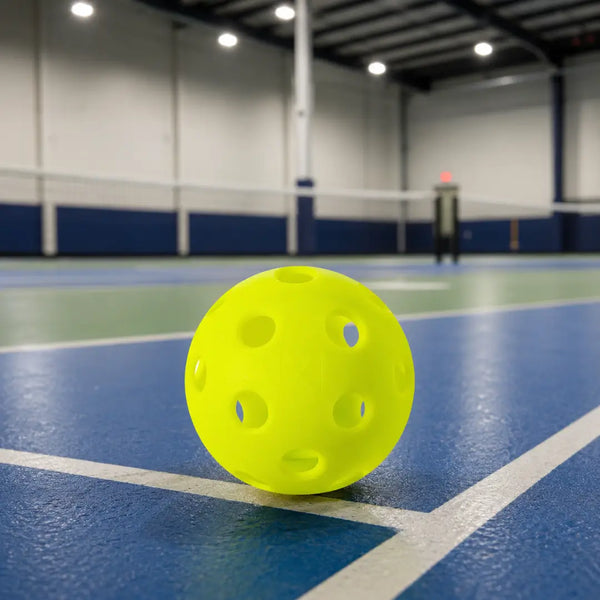
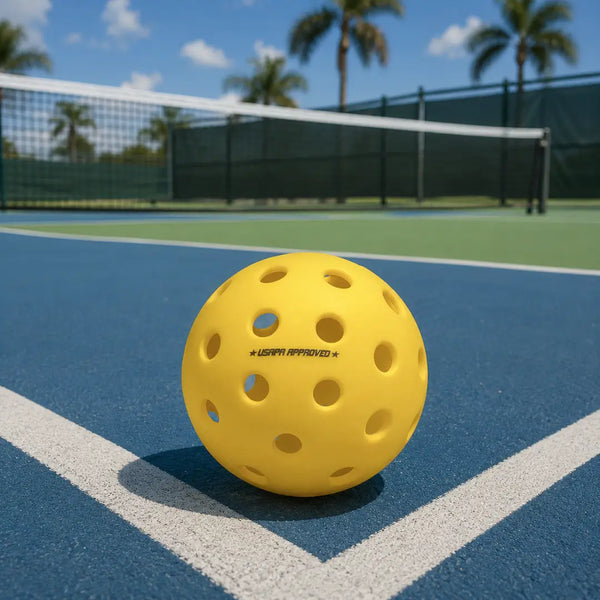
Indoor and outdoor balls differ markedly in their appearance. Indoor balls have twenty-six large holes around 0.43 inches in diameter with a softer shell. Outdoor balls have forty small holes around 0.28 inches in diameter, and with a harder shell. Indoor balls typically weigh 0.80 to 0.92 ounces while outdoor balls weigh around 0.90 ounces. Noise-wise, indoor balls are much quieter than outdoor balls.
Most pickleballs are made of durable plastic, resin, or polymer, usually polyethylene (PE) and polypropylene (PP). There are also foam balls that are designed to be used in places with strict noise level requirements, the smallest type of pickleball and the lightest at around 0.71 ounces. They have the least bounce and spin, but also the best noise reduction at 60 decibels or less, the level of a normal conversation. Feel free to browse through our collection of indoor pickleballs and outdoor pickleballs today.
Swipe to see more
Court Surface
Indoor balls are made for smooth floors such as linoleum, hardwood gym floors, rubber, and sport court ones. Outdoor balls are designed for much rougher court surfaces such as concrete and asphalt. That is why indoor balls tend to last much longer than outdoor balls, up to a year, while outdoor balls usually last from one to several months.
So indoor balls should be used in indoor courts, and outdoor balls in outdoor ones, right? It’s a bit more complicated than that. While most indoor courts have smooth surfaces, some centers and multi-sport complexes have installed the same hard material as outdoor courts to replicate the experience. The result will have your indoor balls weathered and worn down before their time. In that case, it is best to use outdoor balls. Doing your research or asking an indoor court facility what kind of surface they have would help you make the best decision with regards to your gameplay.
For players who play on both indoor and outdoor courts, having a mix of both is a good idea. For places with strict noise-level restrictions, foam balls would do best as the quietest type of pickleball.
Swipe to see more
Playability & Common Problems
Both indoor and outdoor balls differ in terms of how they play. Outdoor balls move faster and they are louder, with a sharper “pop” than indoor balls. Climate also has a big effect on the ball. The holes in the pickleball function as air brakes; larger holes slow the ball and add lift while smaller holes keep the line tight and reduce drag.
Wind, thus, is a crucial factor, especially with the low weight of the pickleball; even a mild crosswind can push balls laterally during their arc. It is recommended that you make adjustments to your game based on which way the wind is blowing. Playing aggressively into the wind can help mitigate the lack of velocity, but if you find the wind accelerates your ball, playing more conservatively to the wind makes more sense. Elevation and high altitude also impact your game tremendously. Thin air makes the ball fly more, and with high altitudes, a slightly softer outdoor ball can keep shots down.
Both indoor and outdoor balls wear down over time, though in slightly different ways. Indoor balls tend to go mushy and lose “pop,” softening with time. While they do not crack as often, they tend to pick up scuffs. A key sign your indoor ball is on its last legs is when your dinks die on the net for no good reason.
Outdoor balls, naturally, suffer more damage, being exposed to sun, wind, and rough courts. They crack or split more often and develop an uneven bounce more easily. Cold temperatures are especially a problem; once they drop below freezing (32°F or 0°C), your pickleballs become brittle and prone to cracking. One way to prevent the balls cracking in colder weather is to warm them up in your pocket or in your bag. Hot temperatures are a problem as well, with extremely high heat making your pickleballs become softer and warp, thereby affecting their performance.
Foam balls vary in their durability depending on whether they are made from high-density foam (which mimics the weight, size, and bounce height of standard pickleballs) or low-impact, high-durability foam. The latter, as its name suggests, is more durable, soft, and resilient, designed for indoor environments with few stressors.
Maintenance Tips
Pickleballs of all types accumulate dirt and grit easily on all types of courts. Giving them a quick wipe with a damp cloth on the regular helps, but a deep clean will ensure your pickleballs are in tip-top shape. Fortunately, cleaning your pickleballs is an easy matter. All you need is a bucket or large bowl, some mild soap, a damp cloth or a sponge, and a towel for drying.
- Fill the bucket with warm water.
- Add a few drops of mild soap (dishwashing soap works well). Stir gently to mix.
- Soak pickleballs in water for a few minutes. This will help loosen the accumulated dirt and grime.
- Use a soft cloth or a sponge to gently scrub the balls. Make sure not to scrub too hard, or you will damage the surface texture.
- Rinse them under clean running water to remove the soap residue. Otherwise, the balls will remain slippery.
- Pat the balls dry with a towel or allow them to air-dry in a well-ventilated area. Avoid direct sunlight, as the heat will degrade the plastic.
You should also inspect your pickleballs for signs of wear or damage and replace the ones that need to be replaced. If you have separate balls for practice and official games, then we recommend keeping them in separate containers.
FAQs
Which pickleballs are best for beginners?
Indoor balls tend to be more forgiving than outdoor ones, being slower and more durable. They also bounce higher and slower off smooth floors, making them more beginner-friendly. Playing on an indoor court is recommended overall as an easy environment to grasp the fundamentals before switching to a hard court. For more information on choosing the right ball for your skill level, check out our helpful guide.
Should I change my paddle according to the type of ball I use?
No, it isn’t necessary. The differences between playing with an indoor versus an outdoor ball are very subtle. An outdoor ball has less dwell time and comes off the paddle face faster than an indoor ball. Drops and dinks are slightly less forgiving with outdoor balls. By contrast, indoor balls tend to grab the paddle face more readily. A paddle with a thicker core (more than fourteen millimeters) would work better with harder balls.
Otherwise, the same conditions apply whether you play indoors or outdoors: The same court, serve, and scoring. It is much better to adjust to touch rather than change your equipment entirely.
How do I store my pickleballs?
Store your pickleballs in a dry, climate-controlled area. Avoid extreme temperatures, either hot or cold, and especially direct sunlight, as the latter can degrade the plastic and make it brittle. Make sure you avoid moisture, as that can lead to mold and mildew. Do not cram too many balls into a single container; that can deform them and cause them to lose shape.
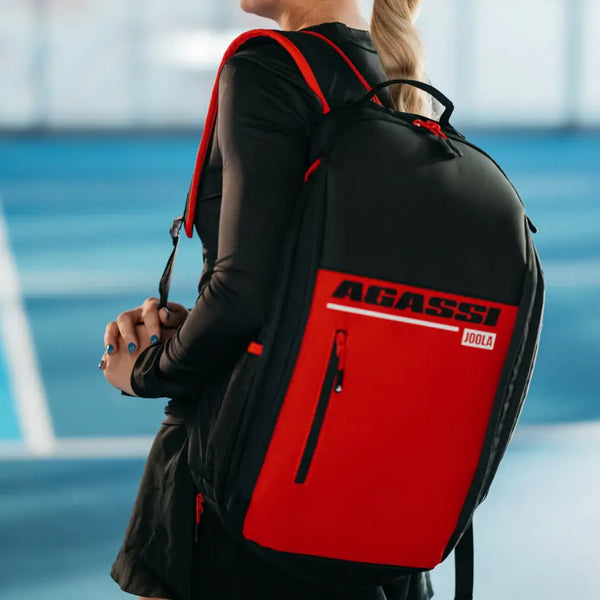
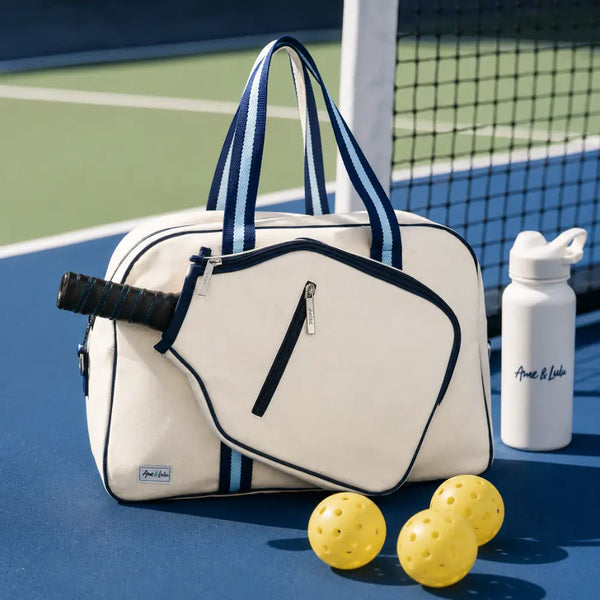
We recommend using mesh bags or containers with ventilation holes. A dedicated sports bag or compartment for balls would be ideal. We offer tons of pickleball bags and totes that provide crucial protection for your sports equipment, including pickleballs.
Swipe to see more
What are common mistakes players commit regarding pickleballs?
Some common mistakes players make include using cracked outdoor balls, which increases the chances of mishits. Using an indoor ball outside on a windy day is also not recommended, as your drop shots will sail. Buying only by color is also a mistake, as hole count and the model are more important considerations.
Discover Our Quality Pickleball Balls Today
Regardless of which type you use, one thing is for sure: If your pickleballs are cracking or warping, then it is time to replace them. Whether you play on an indoor or outdoor court or switch it up, you can find what you need at Pickleball Express. We carry USAPA-approved balls for practice, training, matches, and tournaments, both indoor and outdoor. We also provide diverse storage options for your pickleballs that will protect them from damage.
Pickleball Express is committed to serving our customers in all their racquet sport needs. To learn more about our products and pickleball in general, visit our helpful blog or shop our pickleball collection today.

